Back to all articles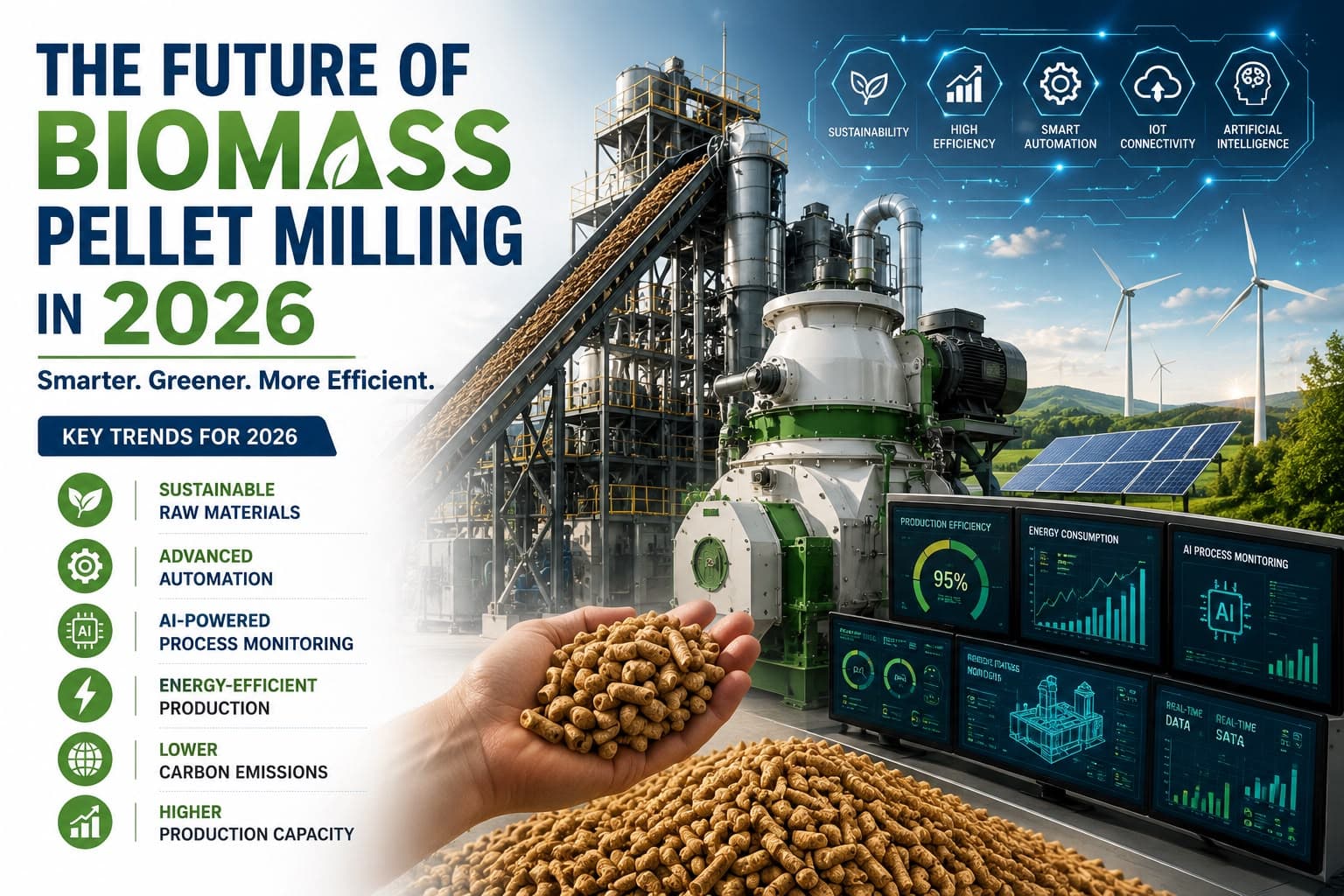
Biomass Pellet15 June 202610 min read
The Future of Biomass Pellet Milling: Trends Shaping the Industry in 2026
T
Team Milling EquipsThe biomass pellet milling industry is undergoing rapid transformation. Driven by tightening carbon regulations, surging demand for renewable solid fuels, and major leaps in process automation, pellet producers who fail to adapt risk being left behind.
The biomass pellet milling industry is undergoing rapid transformation. Driven by tightening carbon regulations, surging demand for renewable solid fuels, and major leaps in process automation, pellet producers who fail to adapt risk being left behind by faster-moving competitors. From ring die innovations to AI-driven quality control, the industry in 2026 looks markedly different from just five years ago.
Whether you operate a dedicated wood pellet plant, an agricultural residue pelletising unit, or a multi-feedstock biomass facility, understanding these shifts is essential to future-proofing your operation. At Milling Equips, we work with biomass pellet producers across India and internationally to deliver advanced pellet milling solutions aligned with where the market is heading.
1. High-Efficiency Ring Die Technology Is Setting a New Performance Baseline
The ring die pellet mill remains the workhorse of large-scale biomass pelletisation — but the design standards expected of it in 2026 are significantly more demanding. The new benchmark is feedstock-specific die engineering, where die hole geometry, compression ratio, and surface treatment are precisely matched to the moisture content, lignin profile, and bulk density of the incoming biomass. [Source: IEA Bioenergy — Pellets as an Energy Carrier]
Key developments in ring die technology:
- ✔ Longer L/D ratios for high-density pellet production from low-lignin agricultural residues such as rice husk and cotton stalk
- ✔ Chrome-molybdenum alloy dies offering 40–60% longer service life in abrasive feedstocks vs. standard carbon steel
- ✔ Stepped bore die profiles that reduce resistance on material entry, improving throughput and reducing motor amperage draw
- ✔ Anti-bridging roller configurations designed for lightweight, fibrous biomass types prone to compaction before the die gap
Pro Tip from Milling Equips
Specifying the wrong die compression ratio for your biomass feedstock is one of the most expensive mistakes a pellet plant operator can make — resulting in crumbling pellets, overloaded motors, or premature die failure. Always validate your die specification against a representative sample of your actual incoming material.
2. Automation and PLC-Based Process Control Are Becoming Standard
Manual pellet mill operation is being replaced by closed-loop PLC automation. In 2026, even mid-sized biomass pellet plants are integrating programmable logic controllers that continuously optimise operating parameters in real time. [Source: McKinsey & Co — Industry 4.0 Manufacturing]
- ✔ Consistent pellet durability index (PDI) across production runs — regardless of operator skill level
- ✔ Automatic load management preventing motor overload during feedstock variability events
- ✔ Recipe-based batch switching for multi-feedstock plants handling wood chips, straw, and agri-residues on the same line
- ✔ Integration with upstream dryers and downstream coolers for whole-line process synchronisation
Process Automation Insight
Explore our automation service solutions to see how Milling Equips is helping biomass producers implement plant-wide digital control.
3. Energy Efficiency Is No Longer Optional — It Is a Competitive Differentiator
With electricity costs rising across India and international markets demanding verified sustainability credentials, energy consumption per tonne of pellet produced has become a key commercial metric. Plants running at 80–120 kWh/tonne are uncompetitive against operations achieving 55–70 kWh/tonne with modern equipment. [Source: IEA — Industrial Energy Efficiency]
- ✔ Variable frequency drives (VFDs) on pellet mill main drives and conditioner motors — delivering 15–25% electricity savings
- ✔ High-efficiency counterflow coolers reducing pellet moisture to target specification with minimal thermal energy input
- ✔ Optimised hammer mill screen selection to achieve target particle size with minimum grinding passes
- ✔ Heat recovery from dryer exhaust for pre-heating incoming biomass, reducing dryer fuel consumption by 10–18%
Energy Benchmark
A well-optimised biomass pellet plant processing wood chips should target 55–70 kWh per tonne of finished pellets. If your plant is running above 90 kWh/tonne, a Milling Equips process audit can identify the primary sources of energy waste.
4. Multi-Feedstock Capability Is Driving Plant Design Decisions
The industry trend in 2026 is decisively towards multi-feedstock plant designs capable of processing wood residues, agricultural straws, energy crops, and industrial organic waste on the same milling line. [Source: IRENA — Renewable Power Generation Costs]
- ✔ Modular die and roller change systems allowing rapid changeover between feedstock-specific configurations (target: under 45 minutes)
- ✔ Hammer mill systems with multiple screen size options and reversible rotor configurations
- ✔ Conditioner designs capable of handling low-moisture wood (8–10%) and high-moisture agricultural residues (15–20%)
- ✔ Silo and conveying systems designed for the bulk density range of all planned feedstocks
See our related article on biomass and grain storage solutions for how upstream storage design feeds into feedstock flexibility.
5. Quality Certification and ENplus/ISO Standards Are Reshaping Procurement
International biomass pellet buyers are applying increasingly strict procurement standards. ENplus A1, ENplus A2, and ISO 17225 certification is now a minimum requirement for export-oriented pellet producers. [Source: ENplus Official] [Source: ISO 17225]
- ✔ Pellet diameter tolerance (±0.5 mm) requires precision die manufacturing and regular dimensional inspection
- ✔ Bulk density (ENplus A1: ≥600 kg/m³) demands correct die specification and conditioning temperature control
- ✔ Ash content limits necessitate upstream feedstock screening and segregation
- ✔ Fines content below 1% requires properly specified counterflow cooling and gentle handling in finished product conveyors
6. IoT-Based Remote Monitoring Is Reducing Unplanned Downtime
Biomass pellet plants are often located in remote areas. This has accelerated the adoption of IoT-enabled remote monitoring — allowing plant owners and engineers to track machine health, production throughput, energy consumption, and quality parameters from any location. [Source: McKinsey — The Internet of Things]
- ✔ Vibration and temperature sensors on main bearings providing early warning of wear before catastrophic failure
- ✔ Real-time pellet mill amperage monitoring flagging feedstock inconsistencies or die blockage conditions
- ✔ Remote dryer outlet temperature and moisture tracking ensuring consistent pre-milling feedstock moisture
- ✔ Automated production reporting delivered directly to management dashboards
Future-Proof Operations
Milling Equips offers integrated digital monitoring services for biomass pellet plants, enabling proactive maintenance and remote process optimisation.
7. Sustainability and Carbon Traceability Are Becoming Commercial Requirements
The EU's Renewable Energy Directive (RED III) and India's bioenergy policy frameworks are placing sustainability traceability requirements on biomass supply chains — including the pellet manufacturing stage. [Source: EU RED III Directive] [Source: MNRE India Bioenergy]
- ✔ Energy metering at machine level — kWh consumed per tonne by each piece of equipment
- ✔ Feedstock lot traceability from intake weighbridge through to finished pellet batch records
- ✔ Emission factors for your specific milling process, required for lifecycle assessment (LCA) documentation
- ✔ Equipment efficiency ratings becoming part of sustainability reporting submitted to off-takers and regulators
Sustainability Note
Carbon traceability at the milling stage is no longer just a compliance exercise — it is increasingly a sales tool. Pellet producers who can demonstrate a verified, low-emission manufacturing process will command a premium with European utility buyers and ESG-conscious industrial customers in India.
Industry Trend Summary
| Trend | Key Benefit | Impact |
|---|---|---|
| 1. High-Efficiency Ring Dies | Feedstock-specific L/D ratios | Die life extended 40–60% |
| 2. PLC Automation | Consistent PDI, whole-line control | Reduced operator dependency |
| 3. Energy Optimisation | VFDs + process discipline | Target 55–70 kWh/tonne |
| 4. Multi-Feedstock Design | Rapid die/roller changeover | Feedstock price resilience |
| 5. ENplus / ISO 17225 | Export readiness | Premium market access |
| 6. IoT Remote Monitoring | Proactive bearing/motor alerts | Reduced unplanned downtime |
| 7. Carbon Traceability | LCA-ready batch records | Regulatory & commercial edge |
Conclusion
The biomass pellet milling industry in 2026 rewards producers who invest in precision, efficiency, and adaptability. The gap between well-equipped, digitally integrated pellet plants and those running legacy equipment is widening rapidly — in cost per tonne and in access to premium markets.
Whether you are evaluating a new pellet plant project, upgrading existing milling equipment, or seeking ENplus certification, the decisions you make in the next 12–18 months will define your competitive position for the next decade.
Ready to align your pellet milling operation with where the industry is heading? Contact Milling Equips today for a technical consultation on equipment selection, plant upgrades, or certification readiness.
Frequently Asked Questions (FAQ)
What is driving growth in the biomass pellet milling industry in 2026?
The primary drivers are tightening carbon regulations in Europe and Asia, the phase-out of coal in power generation, rising demand from industrial boiler operators seeking ENplus-certified fuel, and improving economics of biomass pellet production as milling technology becomes more efficient and automated.
How do I know if my pellet mill die specification is correct for my feedstock?
The correct L/D ratio and hole diameter depend on your feedstock's moisture content, lignin content, particle size distribution, and target pellet density. A feedstock-specific die specification trial — run at controlled conditions — is the industry-standard method to validate die selection before committing to full production volumes.
Is ENplus certification necessary for selling biomass pellets in India?
ENplus certification is currently required primarily for export to European markets. For domestic sales in India, ISO 17225-based specifications are increasingly referenced by large industrial buyers and power producers. Obtaining ENplus certification positions Indian pellet producers competitively for export and signals quality commitment to all buyers.
What is a realistic energy consumption benchmark for a biomass pellet mill?
A well-optimised ring die pellet mill processing wood chips or agricultural residues should consume between 55 and 70 kWh per tonne of finished pellets. Older or poorly specified equipment often runs at 90–120 kWh/tonne — representing a difference of ₹300–600 per tonne of pellets produced at scale.
How can Milling Equips help with biomass pellet plant upgrades?
Milling Equips provides end-to-end support for biomass pellet plant projects — from feedstock analysis and equipment specification through to installation, commissioning, operator training, and ongoing maintenance support. We also supply OEM-compatible spare parts and offer remote digital monitoring services for operating plants. Contact us to learn more.
Ready to upgrade your milling setup?
Discuss your plant requirements with our engineering team today.