Back to all articles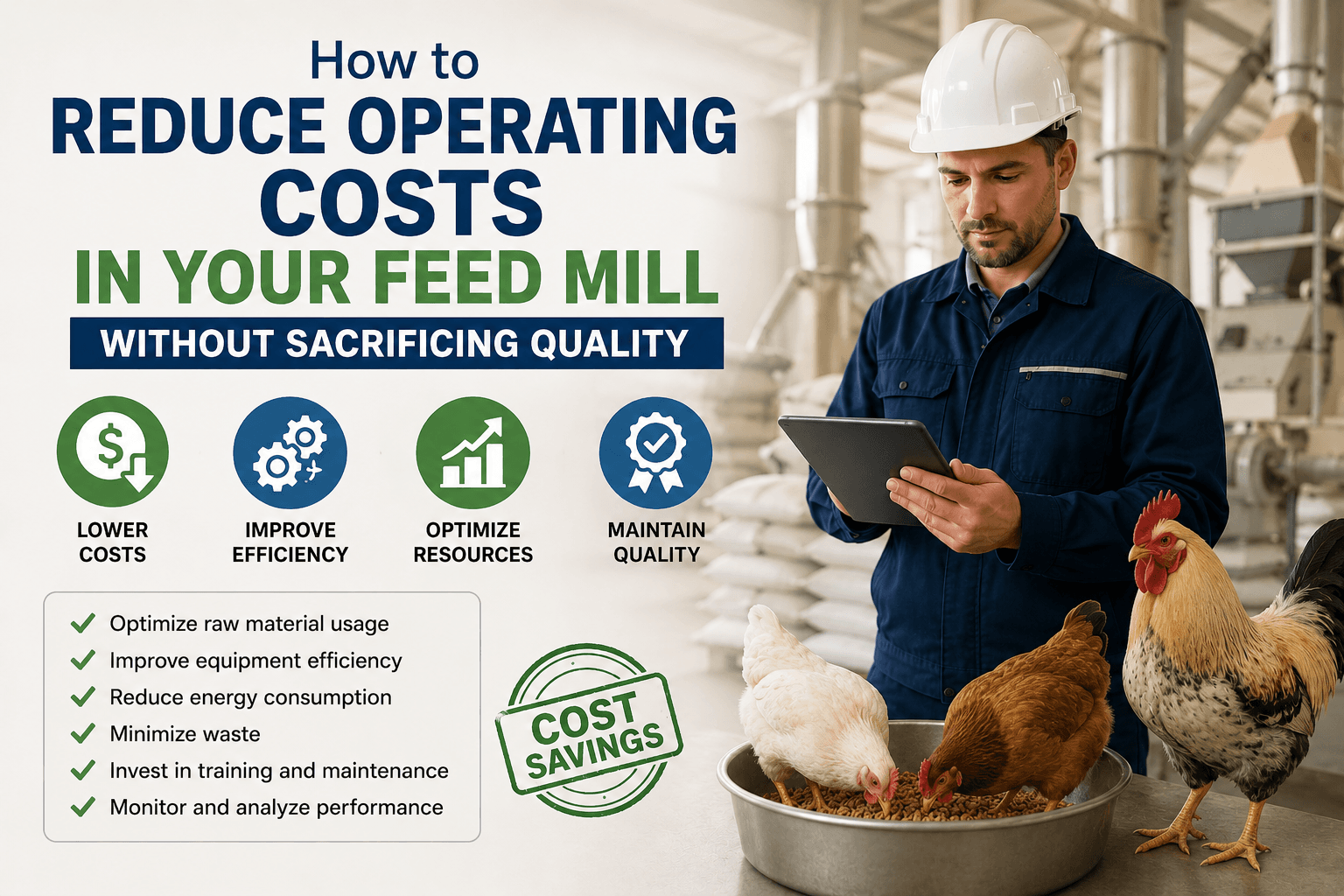
Feed MillingMay 11, 20266 min read
How to Reduce Operating Costs in Your Feed Mill Without Sacrificing Quality
T
Team Milling EquipsExplore proven strategies to reduce operating costs, boost throughput, and maintain consistent feed quality in modern feed mills.
Running a feed mill is a capital-intensive operation. Between energy bills, raw material costs, machinery wear, and labour expenses, margins can quickly erode — especially in today’s competitive feed manufacturing landscape. But cutting corners on quality is never the answer. The good news? With the right strategies, smart feed millers can significantly reduce operating costs while maintaining — and even improving — output quality. In this guide, we break down actionable, proven approaches to optimise your feed mill operations.
Whether you operate a poultry feed plant, an aqua feed facility, or a cattle feed mill, these principles apply universally. At Milling Equips, we work closely with feed manufacturers across India and beyond to deliver high-performance feed milling solutions that balance productivity with profitability.
1. Conduct a Comprehensive Energy Audit
Energy is typically the second-largest operating expense in any feed mill — after raw materials. Motors, pellet mills, hammer mills, dryers, and conveyors all consume significant power. An energy audit can reveal:
- Oversized or underperforming motors drawing excess current
- Compressed air leaks wasting pneumatic energy
- Poor power factor resulting in penalty charges from utilities
- Inefficient lighting and HVAC in processing areas
After auditing, prioritise upgrades like variable frequency drives (VFDs) on motors, high-efficiency pellet dies, and LED lighting. According to the International Energy Agency (IEA), industrial motor systems account for over 40% of global electricity consumption — even a 10% efficiency gain translates to major savings.
💡 Pro Tip from Milling Equips
Installing VFDs on your pellet mill motors can reduce energy consumption by 15–25%, with a typical payback period of under 18 months.
2. Implement Preventive Maintenance Programmes
Reactive maintenance — fixing machinery only when it breaks — is one of the most expensive habits in feed manufacturing. Unplanned downtime can cost a mid-sized feed mill ₹50,000 to ₹2,00,000 per hour in lost production and emergency repair costs.
A structured preventive maintenance programme focuses on:
- Scheduled inspections of pellet mill dies, rollers, and bearings
- Regular lubrication of all rotating components
- Vibration analysis and thermographic checks to detect early failures
- Replacement of wear parts before they cause cascading damage
At Milling Equips, our maintenance services are designed to extend equipment life and minimise production interruptions. A well-maintained pellet mill die, for example, can last 30–50% longer than one that is only serviced reactively.
3. Optimise Raw Material Procurement & Storage
Raw material waste is a silent cost killer. Spoilage during grain storage, incorrect moisture levels, and poor inventory management all add up. Here’s how to address this:
- ✔ Invest in proper grain silos and storage solutions with adequate aeration and moisture monitoring
- ✔ Implement a "First-In, First-Out" (FIFO) inventory system
- ✔ Negotiate bulk purchasing agreements with suppliers to secure better rates during harvest seasons
4. Invest in Automation and Process Control
Manual operations are prone to human error, which can lead to formulation inaccuracies, wasted ingredients, and inconsistent feed quality. Modernizing your plant with a centralized automation control system allows you to:
- Achieve pinpoint accuracy in micro-dosing and batching
- Monitor real-time energy consumption and machinery health
- Reduce the dependency on manual labour for repetitive tasks
- Generate detailed production reports to identify bottlenecks
While automation requires an initial investment, the long-term savings in labour, reduced waste, and increased throughput make it one of the most ROI-positive upgrades for any feed mill.
Conclusion
Reducing operating costs isn't about making cuts; it's about making smart optimisations. By focusing on energy efficiency, preventive maintenance, smart storage, and automation, feed mills can safeguard their profit margins and secure their competitive edge.
If you’re looking to upgrade your facility or need a technical audit of your current operations, the experts at Milling Equips are here to help. Contact us today to discuss how we can engineer greater efficiency into your plant.
Ready to upgrade your milling setup?
Discuss your plant requirements with our engineering team today.