Back to all articles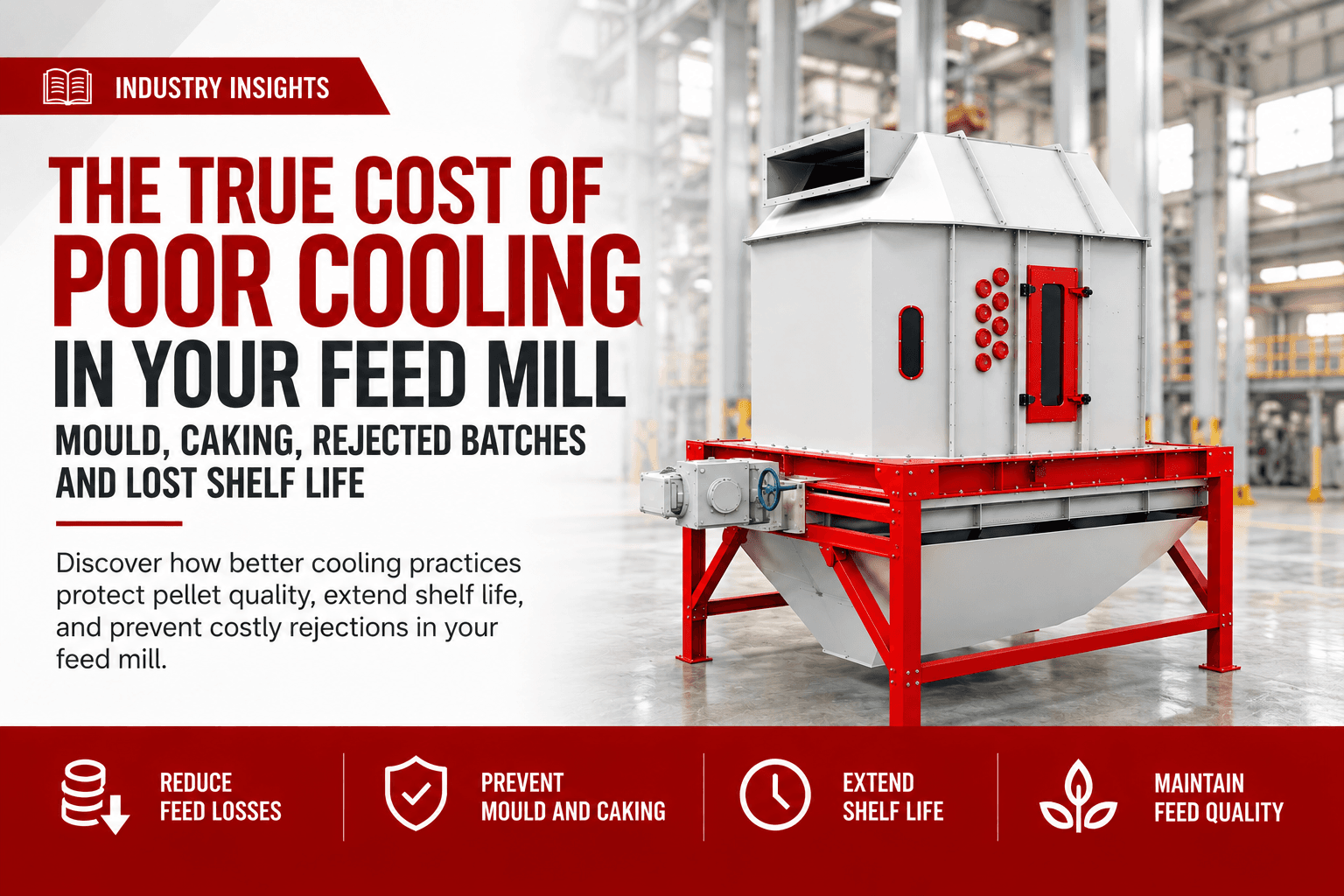
Industry Insights05 October 202611 min read
The True Cost of Poor Cooling in Your Feed Mill: Mould, Caking, Rejected Batches and Lost Shelf Life
T
Team Milling EquipsDiscover the true cost of poor cooling in your feed mill and how better cooling practices directly improve pellet shelf life. Learn how mould, caking and rejected batches drain your profits.
In feed manufacturing, grinding gets the attention, pelleting gets the investment, and cooling gets overlooked. Yet cooling is the final quality gate in your entire production process. Every improvement made upstream in raw material quality, grinding, mixing, and pelleting can be undone in minutes by a cooler that is undersized, poorly maintained, or incorrectly operated.
When pellets leave the pellet mill at 70 to 85 degrees Celsius and 15 to 17% moisture, they are in their most vulnerable state. The decisions made in the next few minutes of cooling determine whether your product reaches your customer in perfect condition or arrives as a caked, mouldy, fragile batch that destroys your reputation and triggers costly returns.
This blog covers two dimensions that every feed mill operator needs to understand: what poor cooling actually costs your business in financial and reputational terms, and how better cooling practices directly improve pellet shelf life and protect the quality your customers pay for. At Milling Equips, we support feed manufacturers with complete feed milling solutions including cooling systems designed to protect every tonne your mill produces.
1. What Correct Cooling Actually Does for Your Feed
Before examining what goes wrong, it is important to understand what a correctly functioning cooling system delivers. Cooling is not simply about reducing temperature. It is a controlled moisture and heat removal process that determines the physical and biological stability of your finished product.
| Cooling Function | What It Delivers for Your Product and Business |
|---|---|
| Temperature reduction | Brings pellet temperature to within 5 degrees of ambient before bagging, preventing heat-induced degradation in the bag |
| Moisture removal | Reduces pellet moisture from 15 to 17% down to 11.5 to 12.5%, preventing mould growth during storage and transport |
| Pellet hardening | As pellets cool, starch retrogradation firms the pellet structure, increasing hardness and durability after the mill |
| Microbial stability | Removing heat and excess moisture eliminates the conditions that allow bacteria, yeast, and mould to multiply in finished feed |
| Shelf life extension | Correctly cooled feed has a safe storage life of 3 to 6 months under normal conditions. Poorly cooled feed can begin to degrade within days |
| Safe bagging conditions | Pellets must be cool and dry before contact with packaging to prevent condensation inside bags, which creates localised high-moisture zones |
Target Cooling Specifications
- Pellet temperature at cooler outlet: ambient temperature plus 5 degrees maximum
- Pellet moisture at cooler outlet: 11.5 to 12.5% for compound feed
- Pellet moisture at cooler outlet: 10 to 11% for extruded aqua feed
- Cooling air volume: typically 3 to 5 cubic metres per kg of feed per minute
- Residence time in counterflow cooler: 8 to 15 minutes depending on pellet diameter
- Maximum pellet temperature at bagging: 30 to 35 degrees Celsius
2. The True Financial Cost of Poor Cooling
Poor cooling is not just a quality problem. It is a direct financial drain on your feed mill that compounds across every batch affected. Most operators significantly underestimate the total cost because losses are distributed across multiple categories that are rarely tracked together.
| Cost Category | Typical Financial Impact |
|---|---|
| Product returns and replacements | A single rejected batch from mould or caking can cost Rs 1 to 5 lakhs in direct product replacement, depending on batch size and feed type |
| Customer compensation and discounts | Quality complaints from poor shelf life typically result in price concessions of 3 to 8% on affected batches to retain the customer |
| Emergency re-processing costs | Batches returned for re-pelleting consume additional energy, labour, and machine time with no revenue return |
| Lost future orders | Customers who experience mouldy or caked feed rarely return. A single cooling failure can cost an account worth Rs 20 to 50 lakhs annually |
| Increased waste and disposal | Batches that cannot be re-processed must be disposed of, representing a total loss of raw material and production cost |
| Reputational damage | Word travels fast in the feed industry. A reputation for inconsistent quality suppresses premium pricing and limits market expansion |
Real-World Cost Example
A 10 TPH compound feed plant producing 200 tonnes per day experiences one cooling-related quality failure per month affecting 20 tonnes of finished product.
- Product replacement or disposal: Rs 1.2 to 2.4 lakhs
- Re-processing energy and labour: Rs 15,000 to 25,000
- Customer discount or compensation: Rs 30,000 to 60,000
- Total annual cost of one cooling failure per month: Rs 18 to 36 lakhs
- Investment in a new counterflow cooler: Rs 8 to 15 lakhs
The investment pays for itself in under 6 months.
3. How Poor Cooling Destroys Pellet Shelf Life
Shelf life is one of the most commercially important quality attributes of finished feed. Farmers and distributors plan purchasing schedules, storage capacity, and feeding programmes around the safe storage window your feed provides. When poor cooling shortens that window, it creates a cascade of problems throughout your supply chain.
- ✔ Mould development: pellets bagged above 12.5% moisture create ideal conditions for Aspergillus, Fusarium, and Penicillium moulds. Visible mould typically appears within 5 to 14 days of bagging in warm, humid conditions. At this stage, mycotoxin contamination is already present and invisible to the naked eye
- ✔ Caking and clumping: high-moisture pellets compress under bag weight and fuse together during storage, making feed difficult to discharge from hoppers and feeders. Caked feed is routinely rejected by farmers as unusable
- ✔ Nutritional degradation: heat retained in insufficiently cooled pellets continues to degrade vitamins, enzymes, and amino acids inside the bag. Vitamin E and vitamin C are particularly heat-sensitive and lose potency rapidly in warm, moist conditions
- ✔ Fat oxidation and rancidity: warm, high-moisture conditions accelerate fat oxidation, producing rancid flavours and odours that reduce feed palatability and animal intake. This directly worsens FCR for your customer
- ✔ Reduced safe storage window: correctly cooled compound feed has a safe shelf life of 3 to 6 months under normal storage conditions. Feed bagged at 13.5% moisture may begin to deteriorate within 2 to 4 weeks, creating logistical pressure on distributors and farmers
According to the Food and Agriculture Organization of the United Nations (FAO), mycotoxin contamination in finished feed is a leading cause of livestock health problems globally, with moisture management at the manufacturing stage identified as the primary prevention control point. Cooling is not optional. It is a food safety requirement.
4. The Six Most Common Cooling Failures in Feed Mills
Understanding what goes wrong in the cooling section is the first step toward fixing it. These are the six most frequent cooling failures seen in feed mill operations:
Cooling Failure 1: Undersized Cooler for Production Rate
Symptoms: pellets consistently exiting the cooler above target temperature and moisture, especially during peak production runs.
- ✔ Root cause: the cooler was specified for a lower production rate than the current pellet mill output. As production capacity has increased over time, the cooler has not been upgraded to match
- ✔ Fix: conduct a cooler capacity audit against current production rate. Contact Milling Equips for a capacity assessment and upgrade recommendation
Cooling Failure 2: Blocked or Damaged Cooler Screens
Symptoms: uneven airflow through the pellet bed, hot or moist patches in cooled product, and increased fines generation as product is discharged unevenly.
- ✔ Root cause: pellet fines, dust, and raw material contamination progressively block the cooler screen panels, restricting airflow and creating dead zones in the pellet bed
- ✔ Fix: inspect cooler screens at every shift change, clean screens weekly with compressed air, and replace damaged or permanently blocked screen panels promptly. Stock replacement screens as a critical spare part
Cooling Failure 3: Worn or Faulty Flap Valves
Symptoms: inconsistent pellet residence time in the cooler, product discharging before reaching target temperature and moisture, and poor batch-to-batch cooling consistency.
- ✔ Root cause: counterflow cooler flap valves control the residence time of pellets in the cooling zone. Worn, warped, or seized flap valves discharge product too quickly, reducing effective cooling time
- ✔ Fix: inspect flap valves monthly, replace worn valve rubbers, and check actuator function. A correctly operating flap valve system is critical for consistent cooling performance
Cooling Failure 4: Incorrect Airflow Volume or Direction
Symptoms: product cooling unevenly across the bed width, with one side of the cooler discharging hotter or wetter product than the other.
- ✔ Root cause: in counterflow coolers, air must flow evenly upward through the entire pellet bed. Blocked inlet ducts, incorrect damper settings, or fan wear reduces airflow volume and disrupts the counterflow pattern
- ✔ Fix: measure airflow volume against design specification, inspect and clean inlet ducts and air distribution chambers, and check fan blade condition and motor speed. Adjust dampers seasonally as ambient temperature and humidity change
Cooling Failure 5: Seasonal Adjustment Not Performed
Symptoms: cooling performance that is acceptable in winter but inadequate in summer, with moisture and temperature both above target during hot months.
- ✔ Root cause: ambient temperature in India ranges from 10 to 45 degrees across seasons. A cooler set up for winter conditions will have significantly reduced cooling capacity in summer when incoming air is already warm and humid
- ✔ Fix: adjust cooler residence time upward during summer months and increase airflow volume by adjusting damper settings. Consider installing a pre-cooling air chiller for operations in high-humidity coastal regions
Cooling Failure 6: No Post-Cooler Screening
Symptoms: a high fines percentage in finished bagged product, and customer complaints about dust and breakage despite acceptable PDI at the pellet mill outlet.
- ✔ Root cause: pellets generate fines during cooling and discharge. Without a post-cooler rotary screen or vibrating screen, these fines are bagged with the finished product
- ✔ Fix: install or inspect a post-cooler screening system and ensure the screen aperture is correctly sized to remove fines while retaining whole pellets. Return separated fines to re-pelleting rather than discarding or blending into bags
5. How to Improve Pellet Shelf Life Through Better Cooling Practices
The practical steps below can be implemented immediately in most feed mills and will deliver measurable improvements in pellet shelf life and cooling consistency without requiring major capital expenditure.
| Cooling Practice | Expected Shelf Life and Quality Benefit |
|---|---|
| Maintain cooler outlet moisture below 12.5% | Extends safe shelf life from weeks to 3 to 6 months under normal storage |
| Ensure pellet temperature is within 5 degrees of ambient before bagging | Eliminates condensation inside bags and prevents mould hotspots at bag surface |
| Clean cooler screens at every shift | Restores even airflow and eliminates hot or moist patches in cooled product |
| Adjust residence time seasonally for Indian climate | Maintains cooling performance year-round despite 35 degree temperature swing between seasons |
| Install post-cooler screening | Removes fines before bagging, reducing moisture absorption points and improving bag appearance |
| Log outlet temperature and moisture every batch | Identifies cooling drift early before it becomes a customer complaint or rejected batch |
| Inspect and replace flap valves on schedule | Ensures consistent residence time and eliminates the most common cause of variable cooling output |
Pair these practices with a structured preventive maintenance programme and a stock of critical cooling system spare parts to ensure your cooling section never becomes the weakest link in your production chain. Our maintenance services are built around exactly this.
6. How Cooling Connects to Every Other Stage of Your Feed Mill
Cooling does not operate in isolation. Its performance is directly influenced by everything that happens upstream, and its failures create problems that show up downstream in storage, transport, and at the customer's farm.
- ✔ Grinding and particle size: incorrectly ground meal can produce pellets with uneven density, which cool at different rates across the bed and create moisture variation in the finished product
- ✔ Conditioning quality: over-conditioned meal entering the pellet mill at excess moisture increases the moisture load the cooler must remove, potentially beyond its design capacity
- ✔ Pelleting throughput rate: running the pellet mill above its matched cooler capacity is the single most common cause of insufficient cooling time and high outlet moisture
- ✔ Fat and liquid additions: high fat formulas reduce the rate of moisture evaporation during cooling, requiring longer residence time or lower throughput to reach target moisture
- ✔ Storage and bagging conditions: even correctly cooled feed will deteriorate if stored in hot, humid warehouses or transported in non-ventilated vehicles. Correct cooling buys time. Correct storage protects it
For a complete picture of how each feed mill process connects to the next, read our related blogs on pelleting quality and common problems and the hidden cost of poor grinding.
7. When to Upgrade Your Cooling System
Some cooling problems can be resolved through better maintenance and process management. Others are a signal that the equipment itself needs to be upgraded. Use these indicators to decide which situation you are in. Upgrade your cooler if any of these apply:
- ✔ Your production rate has increased by more than 20% since the cooler was installed
- ✔ Outlet moisture is consistently above 12.5% despite correct maintenance and settings
- ✔ Cooler residence time has been maximised but temperature targets are still not met
- ✔ You are experiencing more than one cooling-related quality incident per month
- ✔ Your cooler is more than 12 to 15 years old with no major refurbishment
- ✔ You have switched to producing larger diameter pellets that require longer cooling
- ✔ You are expanding into aqua feed production, which requires tighter moisture control
Contact Milling Equips for a free cooling system assessment and upgrade recommendation tailored to your production profile.
According to the World Organisation for Animal Health (WOAH), finished feed quality at the point of delivery to the farmer is a direct determinant of animal health outcomes. Your cooling system is the last process step between your production floor and your customer's farm. It deserves the same level of investment and attention as any other critical machine in your plant.
Conclusion
Poor cooling is not a minor operational inconvenience. It is a compounding financial and reputational risk that touches every aspect of your feed mill's commercial performance: product quality, shelf life, customer satisfaction, and brand positioning. The cost of one month of cooling-related quality failures typically exceeds the annual maintenance budget for an entire cooling system.
Better cooling practices, correctly maintained equipment, and the right cooler specification for your production rate are among the highest-return investments available to a feed mill operator. The improvement in pellet shelf life, reduction in rejected batches, and protection of your market reputation deliver returns that go far beyond what any cost-benefit analysis can fully capture.
Ready to assess and improve your cooling operation? Contact the Milling Equips team for a free technical review of your cooling section. Explore our feed milling solutions, maintenance services, and spare parts catalogue to keep your cooling system performing at its best.
Frequently Asked Questions (FAQ)
What is the correct outlet moisture for feed pellets after cooling?
For compound feed including poultry and cattle feed, the target outlet moisture after cooling is 11.5 to 12.5%. For extruded floating aqua feed, the target is 10 to 11%. Pellets bagged above these targets risk mould development, caking, and significantly shortened shelf life during storage and transport.
How long should pellets spend in the counterflow cooler?
Residence time in a counterflow cooler is typically 8 to 15 minutes for standard compound feed pellets, depending on pellet diameter, ambient temperature, and inlet moisture. Larger diameter pellets and higher inlet moisture both require longer residence time. Always validate residence time by measuring outlet temperature and moisture rather than relying on timer settings alone.
How does poor cooling cause mould in finished feed bags?
Mould requires three conditions to develop: moisture above 12.5%, temperature above 25 degrees, and organic material. Finished feed provides the organic material. When pellets are bagged above target moisture and temperature, the bag environment creates exactly the warm, humid conditions that Aspergillus, Fusarium, and Penicillium moulds need to grow. Visible mould typically appears within 5 to 14 days in warm storage conditions.
Can I improve cooling performance without buying a new cooler?
Yes, in many cases. Start by inspecting and cleaning cooler screens, checking and replacing worn flap valves, verifying airflow volume against design specification, and adjusting residence time and damper settings for current ambient conditions. These maintenance and operational actions restore a significant proportion of cooling capacity in most poorly performing coolers without capital investment.
Does Milling Equips supply cooling systems and cooling spare parts?
Yes. Milling Equips supplies counterflow coolers and cooling system components for compound feed and aqua feed production, along with a full range of spare parts including screen panels, flap valves, and discharge mechanisms. Contact our team for a tailored recommendation.
Ready to upgrade your milling setup?
Discuss your plant requirements with our engineering team today.